 Blasterswap
 pool contracts support swaps, liquidity deposits and token recovery
Blasterswap pool contracts on Blast support swaps, liquidity deposits, V2 share redemption and V3 token collection. V2 redemption transfers assets; a V3 decrease credits principal for collection. V3 collection can recover fees while liquidity remains. Blast is winding down, so recovering tokens on Blast and withdrawing them to Ethereum are separate jobs.
- updatedV2 shares and V3 positions record liquidity ownership
For liquidity provision, V2 mints pool shares and V3 creates or increases positions within a selected price range. V2 records liquidity ownership as ERC-20 shares in a pair. V3's NonfungiblePositionManager identifies each ERC-721 position with a token ID. Its position record contains the two assets, the fee setting, range boundaries and remaining liquidity. The provider supplies both tokens for V2, or the amounts that the selected V3 range requires. Deposits into an existing V2 pool should match its reserve ratio; the smaller proportional contribution limits the shares minted. Liquidity provision can earn swap fees, with changing token exposure. V3 liquidity earns swap fees only while the pool price is within its range. Holding the tokens outside a pool avoids that pool exposure. Before selecting an operation, distinguish the underlying tokens from the shares or NFT that represent liquidity ownership. The position owner or an approved operator controls V3 reductions and collections.
Blast requests asset withdrawals to Ethereum during its wind-down. A working pool exit requires network access and the relevant deployed contracts; current frontend availability and individual pool depth remain unconfirmed.
Redeeming V2 shares recovers the pool's current inventory
If the holding is a V2 pool share, redemption returns a proportional amount of each underlying token. The burn calculation uses the pair's token balances and total share supply. It includes any protocol-fee shares that the contract mints before calculating the return. This operation fits a complete or partial removal of pooled exposure. The deposited quantities do not define a fixed repayment amount because trades change the pool's inventory. A liquidity provider therefore bears exposure to both assets, including impermanent loss relative to holding the original tokens separately.
The pair's burn function expects the redeeming shares at the pair address. Anyone can call the pair's burn function, so a removal integration must transfer the shares and burn them within one transaction, with minimum-output protections. Redemption burns those shares and transfers both underlying assets to the specified recipient. A successful exit reduces the share holding and delivers the token amounts that the pool calculates. Those tokens remain on Blast after redemption.
Why can a V3 position show zero liquidity before tokens arrive?
A V3 decrease can set liquidity to zero while leaving tokens owed to the position inside the pool. The position manager records the principal that the pool releases when liquidity decreases. A collection call handles the transfer to a recipient.
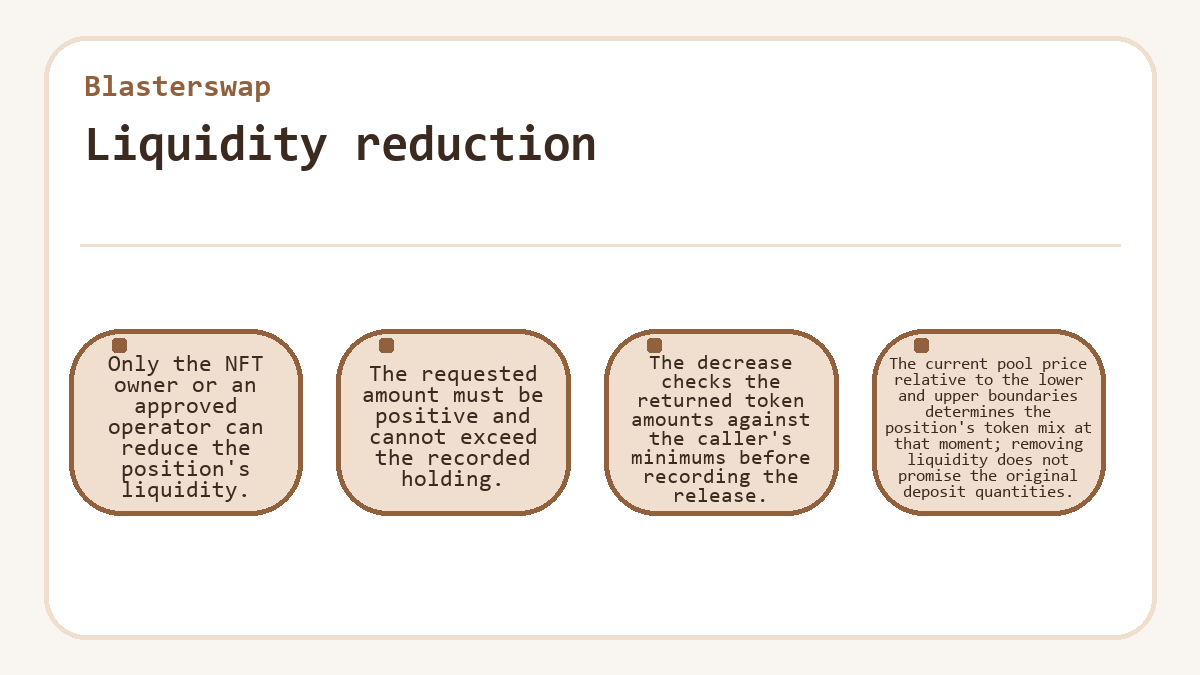
Liquidity reduction
Only the NFT owner or an approved operator can reduce the position's liquidity. The requested amount must be positive and cannot exceed the recorded holding. The decrease checks the returned token amounts against the caller's minimums before recording the release. The current pool price relative to the lower and upper boundaries determines the position's token mix at that moment; removing liquidity does not promise the original deposit quantities.
Token collection
The amount owed
The position manager adds released principal and newly accounted fees to the amounts owed for each token. This accounting entitlement can remain after liquidity reaches zero. Collection can recover fees while keeping liquidity deployed, or transfer principal after a decrease. Requests specify maximum amounts for each asset; at least one maximum must be positive. The contract caps collection at what the position is owed; a request below that entitlement can leave a balance to collect later.
The destination balance
An authorized caller supplies the collection recipient. A zero recipient address selects the position manager itself, so any collected tokens go to that contract. A nonzero address directs the collected tokens to that address.
Swaps exchange tokens when the chosen pool has liquidity
A swap exchanges tokens without requiring ownership of pool shares or a position NFT. For withdrawal, it fits when a recovered asset differs from the token that the selected route accepts. Documented V2 pairs included USDB/WETH, PAC/WETH, PAC/USDB and ORBIT/USDB. These markets require available reserves to execute a conversion. The operation needs the relevant input token, an executable pool path and enough ETH for execution on Blast. A completed swap transfers output tokens to the selected recipient. Shallow liquidity makes a trade move the pool price more, reducing the output that a given input can obtain.
The V2 pair's published swap logic charged 0.3% of the input amount. V3 uses the fee configured for the selected pool. Network gas adds a separate cost. Where a recovered balance already matches the needed asset, conversion adds fees and price exposure without resolving another requirement. Direct withdrawal of ETH or USDB, or unwrapping WETH to ETH, can therefore fit the task better than another trade.
V3 exit parameters allocate control between caller and contract
During a V3 exit, the authorized caller chooses reduction limits and a collection destination that the contracts enforce. The minimums apply to principal released by the decrease; the recipient controls where collection sends tokens. The NFT owner and approved operators have authorization, while collection parameters choose the destination.
| V3 exit parameter | Contract rule | Control over the exit |
|---|---|---|
liquidity
to decrease
|
Positive and no greater than the position's recorded liquidity | The owner or an approved operator chooses how much to remove. |
amount0Min
|
amount0 >= amount0Min
|
The caller sets the minimum acceptable token0 principal from the decrease. |
amount1Min
|
amount1 >= amount1Min
|
The caller sets the minimum acceptable token1 principal from the decrease. |
Collection
recipient
|
A nonzero address receives tokens; zero selects the position manager. | The authorized caller directs collection to the chosen destination. |
Minimum-return checks limit what a decrease accepts at execution; they do not fix the market price beforehand. A stricter minimum can cause the transaction to revert when the returned amount falls below it. Recipient selection governs actual token custody, even when the same person controls the NFT and submits the call.
Pool yield credits differ from retired points and Gold
WETH and USDB yield changed liquidity accounting, while Blast points and Gold belonged to a separate incentive system. Rebasing here concerns the native assets and how pools accounted for their yield. V2 pairs claimed eligible yield and updated reserves before minting or burning shares. For WETH or USDB pools with active liquidity, V3 credited claimed yield through fee-growth accounting during position updates. Consequently, a V3 amount owed can include native yield, and collection alone does not identify how much arose from trading. During wind-down, any further credit depends on yield that is actually claimable by the pool.
The Blast Points API was retired, ending points and Gold accrual under that program. Older contracts contain points-operator settings, which do not establish a current reward entitlement. Token-launch development addressed a separate use from pool redemption. Active launchpad sales and project-specific reward eligibility remain unconfirmed.
WETH and USDB require different withdrawal treatment
For ordinary wallets, WETH requires unwrapping on Blast before ETH withdrawal, while USDB follows the stablecoin withdrawal route. Wrapped ETH cannot enter the bridge's ETH withdrawal balance until it becomes native ETH. USDB withdrawals through the Blast bridge deliver DAI on Ethereum. These rules govern assets that have already left the pool. In the ordinary-wallet flow, the bridge sends assets to the same address on Ethereum that initiates withdrawal on Blast. If the collected tokens remain in another ordinary wallet, that wallet must initiate the withdrawal using its own balance.
The bridge website's ordinary-wallet flow excludes smart contract wallets. Contract-held ETH, USDB and BLAST require their respective contract withdrawal methods. Blast Mobile also has a separate withdrawal flow. The withdrawal flow depends on the account holding the assets and whether the user is withdrawing through Blast Mobile.
Ethereum settlement completes withdrawal from Blast
After pool recovery, an ordinary-wallet withdrawal remains incomplete until the bridge releases the destination assets on Ethereum. ETH withdrawals require a proof after a preparation period of up to one hour. A one-day challenge period follows before the claim transaction can release ETH. USDB also requires proof and the one-day challenge period before finalization. Processing can then take up to another day. Once DAI becomes claimable, the wallet submits another Ethereum transaction to receive it.
A withdrawal needs ETH on both networks: the wallet pays for initiation on Blast and later stages on Ethereum. The wallet also needs enough Blast ETH for any earlier unwrapping or pool operation. Rebasing can leave a small WETH remainder after unwrapping because its balance can change between reading and execution.
Before you start with Blasterswap
What triggers the V2 error INSUFFICIENT_LIQUIDITY_BURNED during an exit?
The V2 pair rejects a burn when either calculated token return is zero. Each return depends on the shares held by the pair, that token's current balance and total share supply. A missing share balance or rounding down to zero can trigger the error.
Does V3 collection refresh fees while liquidity remains in the position?
V3 collection refreshes fee accounting when the position still has liquidity. The position manager calls a zero-amount pool burn to update the fee-growth snapshots, then includes the resulting entitlement in collection. This pool call does not reduce the position's liquidity. The contract still requires an authorized caller and caps each requested collection amount at the tokens owed for that asset.
How can a V3 collection event differ from the tokens actually received?
The V3 position manager's collection event can record a slightly higher amount than the actual token transfer. The position manager emits the capped amount that it requests from the pool. Rounding in the pool can make the returned collection amount a few wei smaller than that request.
Will closing the bridge window cancel a pending withdrawal after a pool exit?
Closing the bridge window does not cancel a withdrawal that the network has already recorded. The ordinary-wallet flow keeps the pending record in the bridge's History tab with the same wallet connected. A later proof, finalization or claim still needs its own transaction when the withdrawal reaches that stage. Closing the window neither completes those operations nor changes the wallet address that will receive the assets.
What does the wad field mean when unwrapping WETH recovered from a pool?
The WETH contract's wad field specifies the raw token amount in wei. One WETH equals 1,000,000,000,000,000,000 wei. A balanceOf result already uses that scale, whereas a wallet display normally converts it into WETH units. The unwrapping method accepts the raw amount. In the documented ordinary-wallet flow, that amount must not exceed the connected wallet's WETH balance.